3:05 PM hits.
Staff members take their posts. Radios crackle. Vehicles stack up at the entrance. Within minutes, the lane is backed up past the school sign. Sound familiar?
Dismissal should be controlled, predictable, and efficient. Instead, it often feels reactive and chaotic.
Vehicles idle. Staff wave frantically. Students cluster near doors. One stalled vehicle slows everything. One miscommunication adds five minutes. Five minutes adds ten more cars.
Why does something so routine create so much disruption?
For administrators and school leaders, dismissal isn’t just about convenience. It’s about safety, liability, community perception, staff fatigue, and operational control.
The question isn’t whether congestion happens. The question is whether your school has a real system to manage it.
If you’re serious about how to reduce school pickup line time, you have to confront the structural problems behind it, not just the visible traffic.
Let’s break them down.
1. Why Is School Pickup So Slow?
The short answer? System design failure.
A 2025 study by Pitt, Macpherson, Fridman, and colleagues looked at 552 elementary schools across seven cities during morning drop-off.
The numbers are blunt.
“Risky driving behaviors were seen at 98% of schools.”
“The most common problem was that 80% of schools had drivers dropping children off on the opposite side of the street.” Students then crossed mid-block. There was no traffic control and no crosswalk.
That slows everything down.
The study also found that schools with better road design, like curb extensions, clear parking signs, and better entrance access, had fewer risky behaviors.
So this is not random chaos. It’s structure.
When drivers stop in the wrong place, block lanes, or create mid-street crossings, flow breaks. One stalled move slows ten cars. Ten slow moves stack into gridlock.
If 120 vehicles arrive in 20 minutes and your lane handles six per minute, a delay is guaranteed.
Slow pickup is rarely about volume alone. It’s about:
- No sequencing
- No arrival coordination
- No real-time visibility
- No predictive management, only reactive scrambling
Without structural flow control, congestion becomes inevitable.
2. How Does Dismissal Traffic Management Work?
Most schools think cones and extra staff equal management. They don’t.
Real dismissal traffic management means fixing the root cause, not just moving cars faster.
At St. Anne’s-Belfield School, a project led by a software design and programming team studied a serious congestion problem. Pickup lines stretched past 40 minutes. Safety risks increased. Emissions increased. Staff stress increased.
The team found the main causes were clear:
- Overlapping dismissal times
- Parents arriving too early
- Single-lane circulation routes
- Too many cars entering the campus at once
Instead of relying on guesswork or trying unrelated incentives, they built a real-time dismissal process. As staff logged each waiting vehicle, they could see the dismissal queue build on a shared screen, keep the flow moving, and adjust immediately to prevent bottlenecks.
That’s modern traffic management. It asks:
- How many vehicles are in the lane right now?
- Where is congestion building?
- Which behaviors are slowing the flow?
- Are staff and students positioned to keep the line moving?
With a shared, real-time view of the queue, adjustments happen instantly. The line moves because staff see the same picture and can act on it together.
3. How to Speed Up Car Rider Dismissal
Speed isn’t about rushing students. It’s about cutting idle time at every step.
A study by Tsai, Cranford, and Lee at North Carolina State University analyzed traffic at 20 elementary school campuses during peak afternoon dismissal.
The numbers were clear:
“60% of carpool vehicles arrived early, staying three times longer than vehicles arriving after dismissal begins.”
“Loading and unloading should take less than 10 seconds per vehicle, and the full process (entry, student loading, exit) should take under 45 seconds.”
“Multiple loading bays with staff to guide students drastically reduce delays.”
When vehicles sit idle, every car behind slows down, and queues grow exponentially. If one car takes too long, it affects dozens of others.
To speed up car rider dismissal:
- Pre-stage students in organized zones
- Minimize vehicle dwell time
- Staff each bay to guide and coordinate loading
- Reduce unnecessary communication delays
- Remove ambiguity from sequencing
Every extra second in the lane multiplies delays.
Structured systems work. When staff know their roles, see the full flow, and follow clear procedures, lines move faster. It’s not magic. It’s engineering applied to school traffic.
4. Is School Pickup Congestion Preventable?
Many think congestion is just part of school dismissal. Data shows it isn’t.
A 2025 study by Kang, Wu, Shi, and Yang analyzed school-run traffic. The findings were clear:
“School-run traffic reduces free-flow by 8.34% during peak hours.”
“Congestion is worse near areas with multiple schools, bus stops, and commercial buildings.”
“The built environment (street layout, transportation access, and nearby businesses) plays a big role in creating traffic jams.”
In other words, traffic isn’t random. The environment and arrival patterns make congestion predictable.
If schools structure arrivals and manage the flow, they can reduce delays significantly.
Preventing congestion requires:
- Logging and sequencing vehicle arrivals
- Recognizing patterns in stacking and delays
- Structuring the order in which vehicles are called
- Coordinating staff actively
When you treat dismissal like an operational system instead of a chaotic scramble, congestion drops, safety improves, and staff control increases.
Traffic isn’t fate. It’s predictable, and it’s fixable.
5. How to Improve School Car Line Efficiency
Improvement starts with control.
Tsai, Cranford, and Lee also emphasized that the goal is to make the car line predictable, smooth, and safe, not just faster.
Key strategies include:
- Define lanes clearly with no crossover to prevent bottlenecks
- Stage students and vehicles in organized areas for orderly loading
- Assign staff roles and communicate clearly
- Remove unnecessary steps that slow the flow
- Track the flow continuously to spot delays and adjust in real time
- Use double lanes at high-density points to prevent spillage onto nearby roads
Think of your car line like infrastructure: every lane, bay, staff position, and timing choice should have a purpose.
Ask yourself:
- Where does uncertainty happen?
- Where do staff repeat effort?
- Where does time stall?
Fix these friction points. Lines shorten naturally. Safety improves. Staff stress decreases. Your dismissal becomes a system that runs like a well-oiled machine, not a daily scramble.
6. Why Do School Car Lines Fail?
Car lines fail when volume outpaces structure.
The study by Pitt et al. also linked congestion directly to inconsistent enforcement and unpredictable vehicle sequencing.
Failure patterns include:
- No real-time visibility into the queue
- Manual communication delays
- Overlapping dismissal groups
- Unstructured vehicle loading
When sequencing breaks down, congestion multiplies.
Without a shared, accountable process, small delays snowball.
The core issue is not traffic. It’s operational design.
And operational design can be improved.
FAQs
Why is school pickup so slow, even with staff present?
Because staff presence alone doesn’t guarantee structured sequencing or flow control.
How does dismissal traffic management work in schools?
It uses defined lanes, timed sequencing, and coordinated communication to control vehicle throughput.
Can congestion during dismissal be prevented?
Yes. Predictable arrival patterns and structured loading zones reduce stacking and delay.
What is the biggest cause of car line failure?
Lack of real-time coordination and unstructured vehicle sequencing.
How long should an efficient dismissal take?
With structured flow, most schools can significantly reduce average queue time.
Does staggering dismissal help reduce congestion?
Yes. Controlled release timing reduces peak stacking density.
Why do car lines suddenly gridlock?
Because small delays compound when sequencing is unmanaged.
How can schools measure dismissal efficiency?
By reviewing how long dismissal takes and how that time trends day to day, alongside daily rider counts.
Is adding more staff enough to fix traffic?
Not usually. Structural flow improvement matters more than headcount alone.
What makes a dismissal system sustainable long-term?
Clear processes, simple flow metrics, and coordinated staff tools.
Take Control of Dismissal. Don’t Just Manage It.
You’ve seen the patterns. The data is clear.
Congestion grows when systems lack structure. Dismissal slows when the flow isn’t engineered. Lines fail when visibility disappears.
If you’re serious about how to reduce school pickup line time, you need more than cones and radios. You need coordination. Predictability. Shared staff visibility.
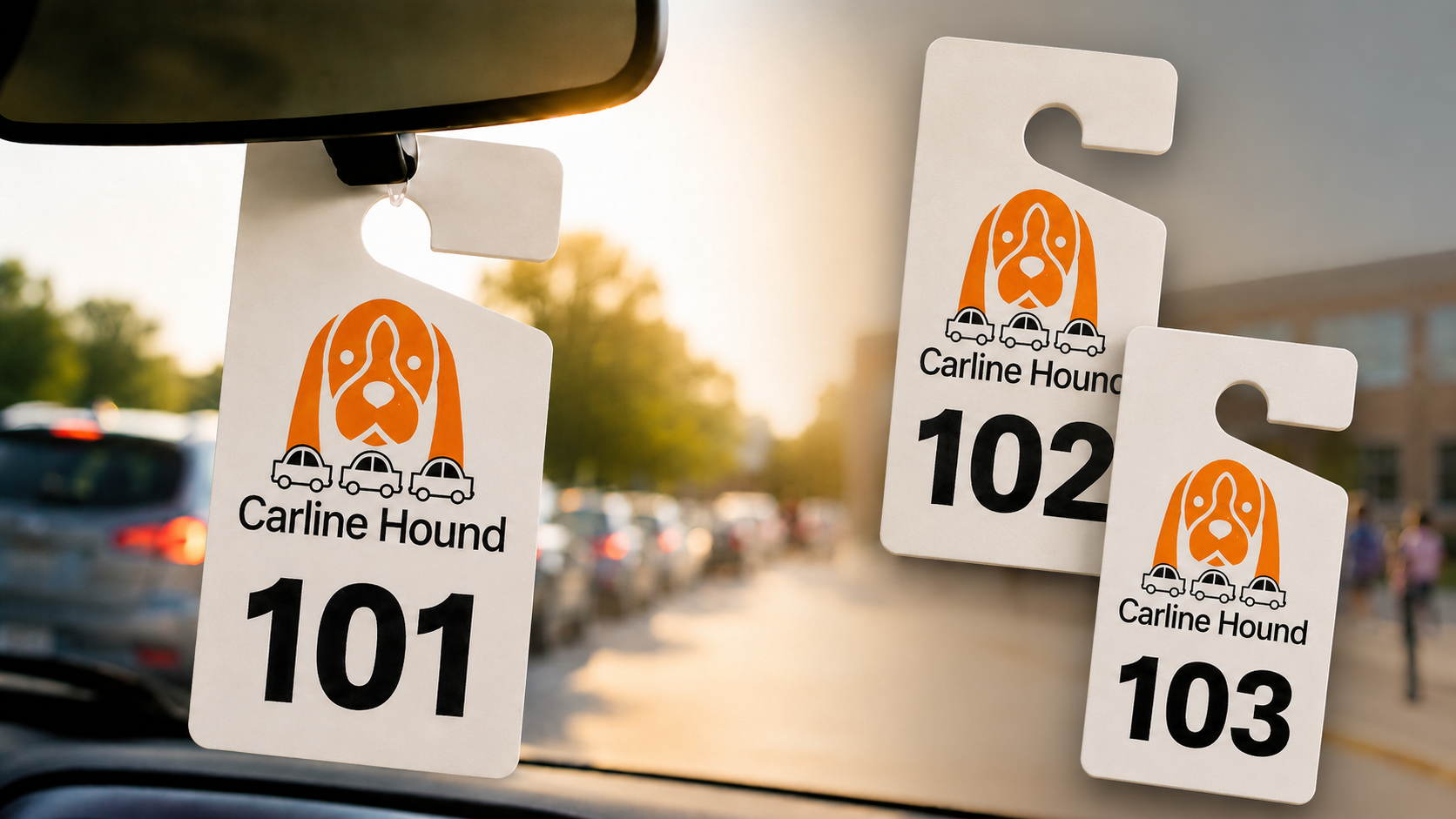
That’s exactly how we approach dismissal at Carline Hound. Staff read each vehicle’s numbered hang tag, enter that number in the app, and the student is queued for pickup, giving everyone on duty the same real-time view of who is up next so the team can follow the school’s established pickup and verification procedures more consistently.
Our system gives teachers and staff structured tools under one subscription, improving sequencing, shared visibility, and operational control, on the phones and devices you already have.
If your dismissal still feels chaotic, it’s not because traffic is unavoidable. It’s because the system needs reinforcement.
It’s time to build dismissal that runs like clockwork. Schedule a demo. See how structured flow changes everything.